Why outsourcing a multi country network often fails — and what works instead
Handing large-scale networks to a single provider often leads to delays, slow changes, and rigid 5-year lock-ins. Learn why owning your roadmap, building a distributed hybrid ops team, and sourcing hardware locally offers a far more agile blueprint.


“Let a large network integrator/provider run your network while you focus on what actually matters.”
It sounds like the ultimate executive dream, right? On the surface, handing over large scale infrastructure to a single vendor seems like the smartest move a company can make.
The process usually starts with a textbook RFP: a crystal-clear scope, unambiguous expectations, and rigorous vetting. The winning vendor promises the world—rapid delivery, full hardware provisioning, experts on call, and seamless 24x7 support. On paper, every single box is checked.
The Reality of the "Turnkey" Global Provider
Once the ink dries on the contract, however, reality often looks nothing like the sales pitch. Instead of peace of mind, organizations frequently run straight into a wall of operational friction:
- Endless delivery delays: Even in major hubs where deployment should be straightforward, timelines routinely slip.
- Logistics and red tape: Shipments stall constantly due to local problems, regional regulations, and supply chain bottlenecks.
- Glacial post-launch agility: Once a site finally goes live, making even minor configuration changes can take months.
- The "expert" gap: Far too often, internal engineers end up stepping in to troubleshoot and fix the provider's mistakes because of missing business application knowledge.
The hardest pill to swallow? Multi-year vendor lock-in. Being tied to a rigid five-year contract means that when the model fails to deliver, there is no room to pivot. There is no flexibility and no fast course correction—the business is simply stuck.
A Better Blueprint: Keep Core Knowledge Close, Source Locally
The flaw in this scenario isn't just picking the wrong vendor; it is the underlying strategy. Some areas of IT are simply too critical to hand over entirely. When the network goes down, the business goes down.
A much more resilient approach to large scale networking flips the traditional outsourcing model on its head:
- Own the architecture and roadmap: Strategy should never be outsourced. A central, company-wide internal team must own the network design, global standards, and long-term roadmap.
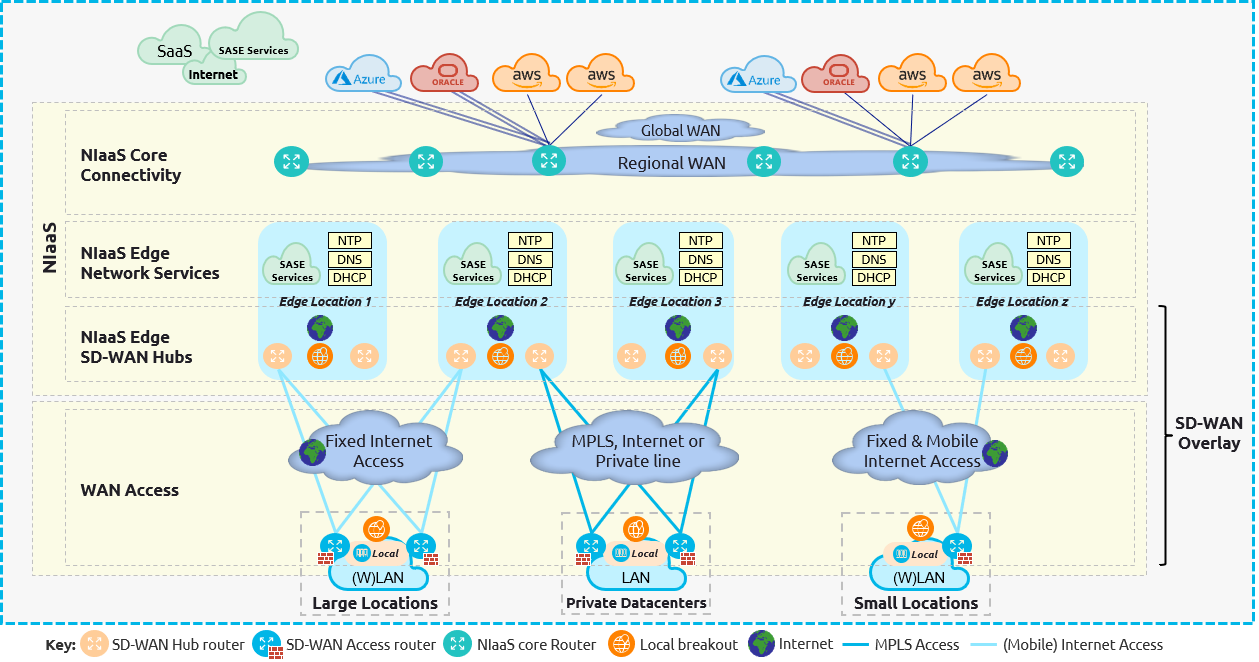
- Use Network Infrastructure as-a-Service (NIaaS) providers: by using services of NIaaS providers as described here, no large physical installed base is needed.
- Build a mixed, distributed, in-house ops team: High-value network engineering and operations belong in-house. That doesn’t require a purely internal staff—a healthy mix of internal engineers paired with people of a capable technical partner will do the job. Also, packing everyone into one expensive headquarters isn't needed; a partly remote network ops team or a low-cost regional hub works brilliantly. Distributed teams can operate completely in sync across time zones.
- Source hardware and connectivity locally: Bypass global customs nightmares by procuring local circuits and hardware directly in the regions where offices are located.
- Rely on "smart hands" on the ground: Physical hands will always be needed to rack a switch, set up a meeting room, or swap out a laptop. However, companies don't need a full-time network engineer in every branch. With clear remote guidance—and trusted regional, on-call technicians when needed—almost anyone on-site, even a savvy office manager, should be able to handle first-line physical setup and troubleshooting.
The Real Challenge Isn't Remote Work—It’s Internal Politics
Transitioning to a distributed, technical partner based, in-house model solves the vendor lock-in problem, though it does introduce a different hurdle: internal politics.
When remote team members are scattered across different regions, local offices will inevitably try to pull strings. An office in one country will demand a specific custom setup, while an office in another country wants something entirely different—and both will try to lobby whichever IT team member sits closest to them.
The antidote to this is strict global standardization backed by unwavering senior management support. When leadership enforces a single, unified design standard, a distributed team can execute smoothly without getting caught in regional tug-of-wars.
Summary
Outsourcing core infrastructure often looks like a shortcut to efficiency, but it frequently ends up costing speed, control, and agility. Staying nimble means keeping core engineering talent close and never handing over the keys to the technology roadmap.