Building a Modern Enterprise WAN Network
As enterprises move to cloud and SaaS, traditional WANs are becoming costly and complex. SD-WAN combined with NIaaS Edge and NIaaS Core enables intelligent routing and flexible connectivity, creating a scalable, vendor-flexible and programmable network for the modern enterprise.

Enterprise networks are undergoing a fundamental change. Applications are moving from traditional data centers into multiple public clouds and SaaS platforms, employees are increasingly distributed, and organizations are operating across more countries and locations than ever before.
At the same time, the traditional model of connecting every branch back to a central data center is becoming less attractive. Backhauling traffic through a headquarters or regional data center can introduce unnecessary latency, consume expensive WAN bandwidth and create additional points of failure.
SD-WAN addresses many of these challenges by separating network control and policy from the underlying transport. But SD-WAN alone does not solve every connectivity problem. Enterprises still need reliable, cost effective, scalable connectivity to cloud providers, data centers, partners and network (access) service providers.
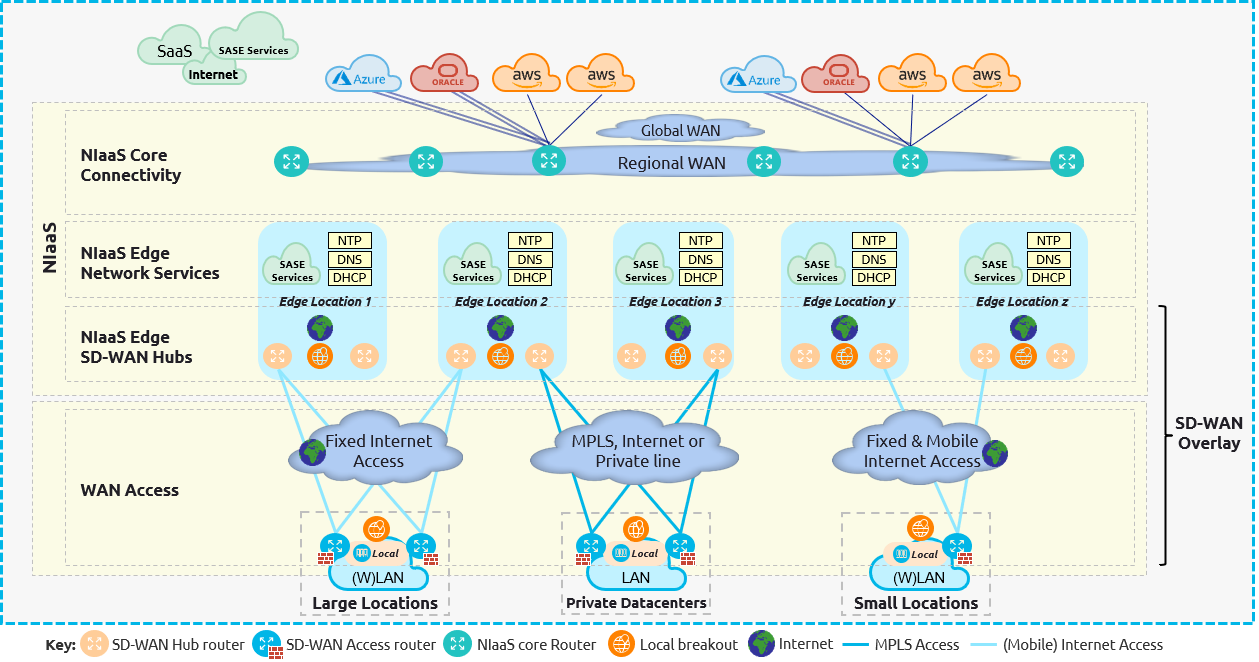
This is where a Network Infrastructure-as-a-Service (NIaaS) portfolio comes in! NIaaS is a lower level service portfolio compared to the well known Network-as-a-Service (NaaS) products of several large MSP's. It gives Enterprise customers access to virtual network components that can be composed at will into a NaaS environment but then tailored to its specific needs. Currently the NIaaS portfolio of several providers like Equinix, Digital Realty & partners, MegaPort and PacketFabric consists of two layers, NIaaS Core connectivity and NIaaS Edge platforms, that can complement an SD-WAN architecture.
Think of it as three interconnecting layers:
- SD-WAN provides the intelligence — application-aware routing (for example secure Internet breakout), path selection, segmentation and policy — and logical separation from access connectivity providers.
- NIaaS Edge provides virtual network infrastructure, allowing virtual SD-WAN gateways, routers and security functions from different networking vendors to run close to users and cloud environments.
- NIaaS Core provides private, software-defined connectivity between those environments and interconnection to clouds, networks and business partners.
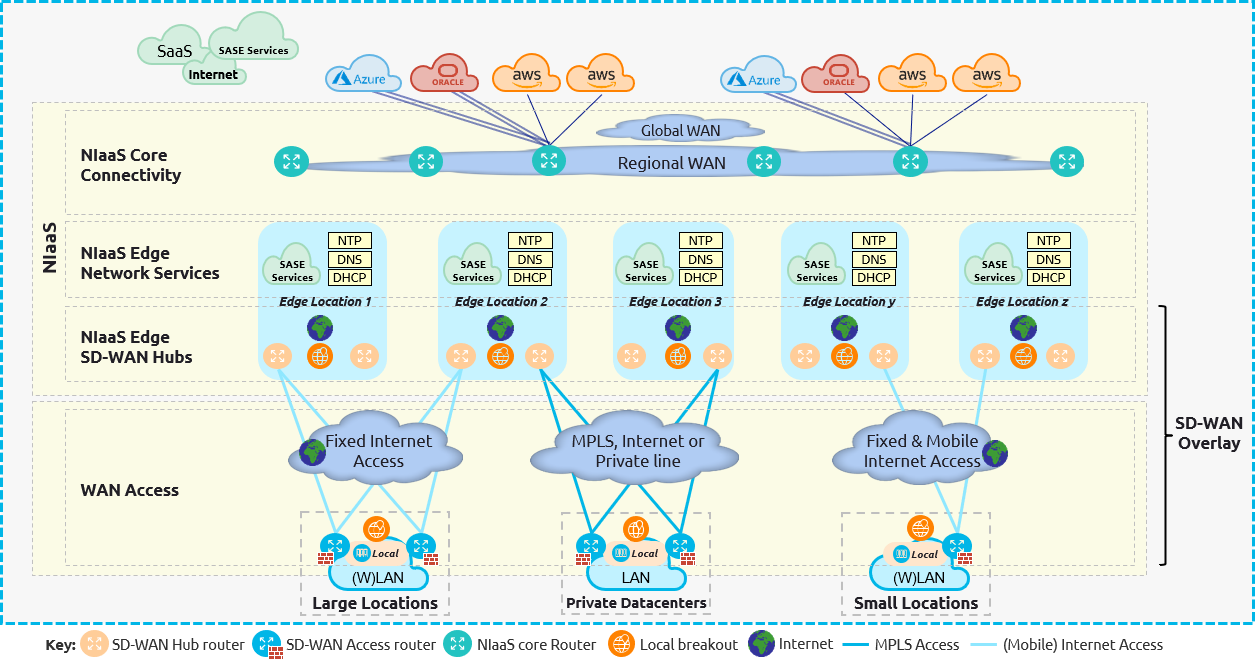
The real value isn't simply connectivity. It's the ability to create a distributed, vendor flexible, programmable network architecture without deploying physical networking infrastructure everywhere, only at the endpoint locations!
For example, a European enterprise could deploy redundant SD-WAN gateways on NIaaS Edge locations in Amsterdam, Paris, Madrid, Milan and Frankfurt, connect them through a NIaaS Core to AWS, Azure and corporate data centers, and have branches dynamically select the appropriate path based on application requirements.
Add automation and infrastructure-as-code, and connectivity becomes something that can increasingly be provisioned like software.
Of course, this isn't a silver bullet. Architecture still needs to address scale, throughput, latency, resilience, IP addressing, security and operational ownership. But the combination points toward an important shift in enterprise networking:
The WAN is becoming a flexible software-defined connectivity platform rather than a collection of fixed, inflexible, difficult to operate and expensive, circuits.
Planning your WAN journey to SD-WAN and NIaaS? Not sure how to translate the technology into a practical, scalable architecture? Let’s discuss your challenges, options and next steps. Get in touch if you’d like to explore how we can support your WAN transformation.